
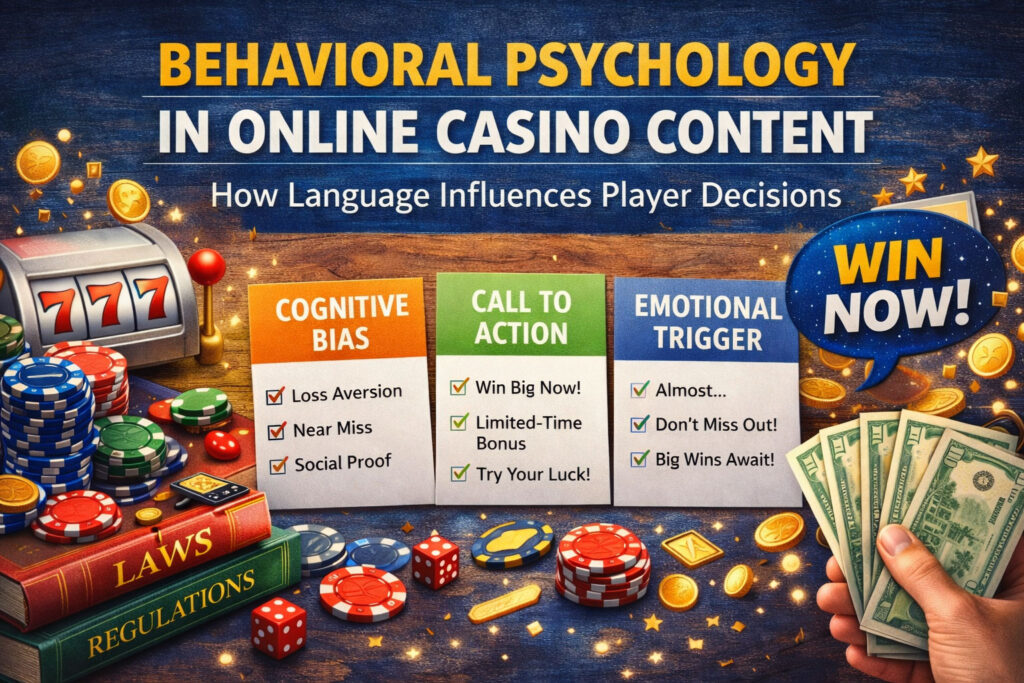
Picture this: someone lands on a casino bonus page around midnight. The banner says “48 Hours Only—Claim Your 200% Match Before Tomorrow.” They weren’t planning to deposit anything. Ten minutes later, they’re entering card details. The next day, scrolling back through browser history, they can’t quite pinpoint what made them act so fast.
Online casino language does more than inform—it engineers choices. Every headline, every button label, every conditional phrase has been selected to trigger specific mental shortcuts. The psychological mechanisms behind gambling content draw from the same research that explains why “limited edition” sneakers sell out in minutes or why stores position impulse buys near checkout lanes. These aren’t random marketing decisions. They’re applications of decades of behavioral science research.
Consider how a site like Jackpot Jill AU presents its welcome offers. The way information gets sequenced, the words chosen to describe wagering requirements, the visual weight given to bonus percentages versus caps—none of this happens accidentally. Each element reflects deliberate choices about which psychological levers to pull and how hard to pull them.
This article examines the cognitive biases and behavioral patterns that casino copywriters exploit, explores where strategic persuasion crosses into manipulative territory, and offers practical frameworks for writing (or evaluating) gambling content more responsibly. Understanding these dynamics matters whether you create this content professionally, review it as an affiliate, or simply want to understand how digital environments shape behavior.
Why Words Hit Harder Than Logic
People like to think they approach money decisions rationally. Behavioral research tells a different story. Under time pressure, emotional arousal, or cognitive load, readers default to heuristics—mental shortcuts that language can easily manipulate. The phrase “instant cashout” creates different neural associations than “standard processing applies,” even when both describe a 24-hour withdrawal window. One feels frictionless. The other sounds bureaucratic.
Casino platforms operate in what UX researchers call “low-attention contexts.” Players scan rather than read. They click before fully processing terms. They make split-second judgments based on headlines and visual hierarchy. This gives copywriters enormous leverage: three or four carefully chosen words can anchor someone’s entire perception of value.
Consider two phrasings for identical bonus terms: “Collect $500 free” versus “Earn up to $500 in bonus credits.” The first implies unconditional ownership. The second hints at conditionality and effort. Neither is dishonest, but the expectations they set couldn’t be more different. The first version primes readers to feel entitled to $500. The second version primes them to understand they’ll need to work for it.
Digital gambling amplifies these effects. Text competes with animated counters showing “winners right now,” countdown timers ticking toward midnight, and celebratory graphics that flash even after losses. Every element fights for attention. The copy that wins is usually the copy that triggers immediate emotional response—not the copy that explains terms most thoroughly or honestly.
Framing Effects and Choice Architecture
Framing is about presentation, not facts. Describe a bonus as “95% claimed by players today” and it feels urgent. Describe the same bonus as “5% still available” and it feels scarce but less pressured. Both statements are mathematically identical, yet they produce different emotional responses. This is framing in action—using emphasis rather than deception to guide perception.
Casino content uses framing constantly. Wagering requirements might live in a collapsible accordion below the fold while bonus percentages dominate the hero section. Players technically have access to complete information, but the visual and linguistic hierarchy tells them what to prioritize. Most follow that guidance without questioning it.
Choice architecture takes this further by structuring options to nudge specific behaviors. When a deposit form defaults to “Yes, send me bonus offers,” most users won’t uncheck it. Inertia is powerful. People follow paths of least resistance. This isn’t an oversight—it’s intentional design based on research showing that default options shape outcomes dramatically. The same principle appears in organ donation rates, retirement savings enrollment, and privacy settings across the web.
- Leading with the highest bonus tier makes lower tiers seem inadequate by comparison
- Describing losses as “unlucky rounds” instead of “money spent”
- Labeling spending caps as “player protection tools” rather than “deposit restrictions”
- Using “claim” rather than “accept”—claiming implies the thing belongs to you already
- Burying withdrawal options three levels deep in navigation while keeping deposits one click away
- Calling wagering requirements “playthrough” (recreational connotation) instead of “rollover” (work connotation)
- Highlighting 200% match percentages in large type while minimizing maximum bonus caps
- Framing cashback as “money returned” instead of “partial loss recovery”
- Using “entertainment” and “games” throughout rather than “gambling” or “wagering”
- Presenting VIP programs as “exclusive membership” rather than “high-roller incentive schemes”
- Positioning “continue playing” buttons prominently on session timeout screens
- Describing bonus forfeiture as “expiration” (neutral) rather than “confiscation” (negative)
Scarcity, Urgency, and Manufactured Pressure
Scarcity activates something primal in human decision-making. When something feels limited, we want it more—even if we didn’t want it much to begin with. This isn’t rational behavior, but it’s deeply ingrained. Casino promotions exploit this relentlessly. “Only 20 bonuses left.” “Expires in 4 hours.” “New players only this week.” Each phrase creates the impression that value will evaporate without immediate action.
The psychological mechanism underlying scarcity is loss aversion, documented extensively by Daniel Kahneman and Amos Tversky. Potential losses hurt more than equivalent gains feel good—roughly twice as much according to their research. So messages about disappearing opportunities land harder than messages about future rewards. A player who sees “Last chance—offer ends tonight” experiences the warning as potential loss even though they never possessed the bonus in the first place.
The ethical problem emerges when scarcity is fabricated. If a “24-hour exclusive” resets daily, it isn’t time-limited—it’s a permanent feature disguised as urgent. Players making decisions based on false scarcity are being manipulated, not persuaded. They’re being denied the information needed for informed choice. Responsible operators use genuine deadlines and communicate them clearly without manufacturing artificial pressure.
| Copy Tactic | What It Triggers | Why It Works | Ethical Alternative |
|---|---|---|---|
| “Grab yours in the next 90 minutes” | Acute time pressure, FOMO | Short windows reduce deliberation and increase impulsive choices | “Available through Friday—review terms at your own pace” |
| “Only 15 spots left today” | Scarcity anxiety, competitive urgency | Creates perception of high demand and exclusivity | “Bonus available to all new signups this month” |
| “Final hours—don’t miss your chance” | Loss aversion, regret prevention | Frames inaction as a mistake rather than a neutral decision | “Promotion ends January 31st at midnight EST” |
| “Trending now—everyone’s claiming this” | Social proof combined with scarcity | Merges fear of missing out with herd behavior | “Popular offer—check the details before deciding” |
| “Hurry—almost gone” | Panic response, fast-twitch decision making | Bypasses analytical thinking in favor of reactive choices | “Limited-time offer with clear end date provided” |
Social Proof and the Illusion of Consensus

Humans are social animals. We look to others for signals about safety, desirability, and normalcy. Casino platforms weaponize this through winner feeds, player counters, and testimonials. “Over 800,000 players trust us” suggests that joining represents a validated, safe decision. “Maria from Perth just won $12,300” implies big wins happen regularly and could happen to you next.
What readers assume: This many active players means the site is legitimate and fun. Someone just won big, so the games must pay out. What the data actually shows: The platform has a large user base—which says nothing about your individual odds or experience. Wins get broadcast while losses stay invisible. One winner among 800,000 active players might represent a 0.000125% probability, but selective highlighting makes it look common.
Social proof also normalizes gambling as routine behavior. Copy that uses phrases like “join the community” or “see what thousands are playing right now” reframes casino participation as a social norm instead of a high-risk financial activity. This framing lowers psychological barriers, especially for new or hesitant players. When something appears normal and popular, people underestimate its risks.
Live winner tickers present another layer of manipulation. Seeing “John – $850,” “Sarah – $1,240,” “Mike – $3,100” scroll past creates the impression of constant payouts. But these feeds rarely provide context: How much did John, Sarah, and Mike wager total? How many thousands of players lost during this same window? Are these even real usernames, or simulated activity designed to suggest momentum? The answer usually involves little transparency and a lot of cherry-picked data.
Loss Aversion and Near-Miss Manipulation
Loss aversion ranks among the most powerful forces in behavioral psychology. Kahneman and Tversky demonstrated that losing $100 hurts about twice as much as winning $100 feels good. Casino copywriters exploit this asymmetry by framing inaction as loss rather than neutral choice.
Look at phrases like “Don’t leave money on the table,” “You’re missing free spins right now,” or “Unclaimed bonuses expire in 6 hours.” Each one implies you’re losing something that already belongs to you. In reality, those spins or that bonus were never yours—they’re conditional offers with strings attached. But the language makes it feel like value is slipping through your fingers if you don’t act.
This tactic becomes especially manipulative when combined with email reminders or push notifications. A player who consciously chose not to claim a bonus receives a message: “Last chance! Your $200 bonus expires tonight—claim it now before it’s gone forever.” The pressure to avoid perceived loss can override the earlier, more considered decision to decline. The player gets nudged back into reconsidering through manufactured urgency tied to loss framing.
The near-miss effect represents another exploitation of loss-adjacent psychology. Near-misses occur when a slot outcome lands “just short” of winning—two jackpot symbols followed by a blank, or bonus symbols one position off the payline. Research published in journals like *Neuron* shows that near-misses activate the same reward circuitry in the brain as actual wins, particularly the ventral striatum. Players experience a rush of dopamine and motivation to continue playing, even though they objectively lost.
Modern slot developers engineer near-miss frequency deliberately. The outcomes are still determined by random number generators, but the visual representation—the spinning reels, the delayed stop, the “so close!” graphics—is carefully choreographed to maximize the near-miss effect. Some games even add sound effects or screen shakes when near-misses occur, heightening the emotional impact. Copy around these games rarely mentions this mechanic, instead focusing on “exciting gameplay” and “immersive graphics.”
Microcopy and the Silent Nudges

Microcopy refers to the small text fragments that guide users through interfaces—button labels, form hints, error messages, confirmation screens, tooltips. These snippets rarely get examined closely, but they shape behavior dramatically. A button reading “Play Now” feels casual and low-stakes compared to “Deposit to Continue.” Both lead to the same financial commitment, but the first downplays it while the second makes it explicit.
Deposit flows contain dozens of microcopy decisions. A field asking “How much would you like to add?” sounds friendly and neutral. “Select deposit amount” is transactional. “How much will you wager today?” would be honest but commercially unviable. The chosen wording reflects calculated decisions about which frame minimizes hesitation and maximizes conversions.
Confirmation screens present another microcopy battlefield. After a player deposits, does the screen say “Transaction successful” or “Great choice—your balance is ready”? The first is neutral acknowledgment. The second is positive reinforcement that validates the decision and primes the player to feel good about spending. Research in behavioral economics shows that validating financial decisions increases likelihood of repeat behavior.
- Button text: “Claim Now” versus “Read Terms and Claim”
- Pre-selected checkboxes on signup forms (marketing consent, bonus acceptance without seeing wagering requirements)
- Confirmation language: “Perfect! You’re all set” versus “Deposit confirmed”
- Suggested amounts: “Most players choose $50” versus “Enter custom amount”
- Error messages: “Oops! Minimum is $20” (friendly, encouraging) versus “Insufficient amount entered” (neutral, factual)
- Withdrawal prompts: “Wait—you have active bonuses, sure you want to cash out?” versus “Confirm withdrawal request”
- Reminder notifications: “Your 50 free spins expire in 2 hours!” versus “Account notification”
- Session timeouts: “Still having fun? Stay logged in!” versus “Session will end in 5 minutes”
- Low-balance alerts: “Top up now and keep the excitement going” versus “Balance: $8.50 remaining”
- Loss messaging: “So close! Try again?” versus “Round complete”
- Auto-play toggles: “Enable continuous play for convenience” versus “Auto-play: off”
- Reality check dismissals: “Keep playing” versus “I understand—continue session”
| UI Text Location | Common Phrasing | Hidden Effect | More Transparent Alternative |
|---|---|---|---|
| Deposit button | “Add Funds” | Sounds like saving money, not spending it | “Deposit” or “Transfer Money” |
| Bonus opt-in | “Activate Your Bonus” | Feels like unlocking a feature, obscures binding terms | “Accept Bonus Terms (40x wagering applies)” |
| Session warning | “Still here? Let’s keep going!” | Encourages continued play beyond intended session length | “You’ve been playing for 2 hours—take a break?” |
| Withdrawal screen | “Cancel and keep your winning streak alive” | Frames canceling withdrawal as the smart move | “Proceed with withdrawal or return to games” |
| Loss streak | “Your luck is about to change—keep spinning” | Exploits gambler’s fallacy by suggesting wins are “due” | “Each spin is independent—outcomes are random” |
Where Persuasion Becomes Manipulation
Persuasion and manipulation exist on a spectrum. Persuasion provides accurate information in compelling ways that help people make informed choices. Manipulation withholds key information or exploits cognitive vulnerabilities to override informed decision-making. The line gets crossed when language is designed to prevent good decisions rather than enable them.
Here’s a concrete example: promoting a “200% match bonus” in 48-point font while placing “60x wagering requirement applies” in 8-point gray text at the bottom of the page is manipulative. Explaining both the match percentage and wagering requirement clearly in the opening paragraph—while still using engaging language—is persuasive. The first approach assumes players won’t read carefully and exploits that assumption. The second approach assumes they will and makes the content worth reading.
Context and risk level matter enormously. Someone browsing casually might not need exhaustive detail in a banner ad. But someone about to deposit $500 deserves crystal-clear warnings about rollover requirements, withdrawal conditions, maximum cashout limits, and realistic win probabilities before they commit. Responsible copywriting scales transparency to match stakes.
The behavioral psychology research also reveals concerning patterns around vulnerability. Studies show that personalization algorithms can identify players showing signs of problem gambling—increased bet sizes after losses, extended sessions, chasing behavior. Ethical platforms use this data to trigger interventions. Unethical platforms use it to serve more aggressive offers or extend “exclusive bonuses” that keep vulnerable players engaged longer.
- Terms written so vaguely they require legal expertise to parse correctly
- Countdown timers that reset or extend silently after supposedly expiring
- Winner announcements without any context about house edge, payout percentages, or player volume
- Gamifying deposits through achievement systems tied to spending milestones
- Push notifications timed for moments of likely vulnerability (late night, after losing streaks detected)
- Language that reframes addiction indicators as “bad luck streaks” or “rough patches”
- Opt-out systems requiring multiple steps while opt-in happens with one click
- Bonus structures deliberately designed to encourage chasing losses to meet wagering requirements
- Using “almost won” or “so close!” messaging that exploits the near-miss effect
- Withdrawal friction—delays, verification requests, “are you sure?” prompts designed to reverse decisions
Writing Responsibly in a High-Risk Category
Responsible casino content balances commercial objectives with harm reduction. This doesn’t mean abandoning persuasive language—it means using persuasion honestly and transparently. Clear terms, plain-language explanations, and prominent safer-gambling resources should be baseline standards, not afterthoughts.
Wagering requirements make an excellent test case. Rather than hiding them in footnotes or using opaque industry jargon, responsible copy explains them plainly: “This bonus requires 40x wagering. That means for a $100 bonus, you’ll need to place $4,000 in total bets before you can withdraw any winnings.” This transparency doesn’t eliminate the requirement, but it enables informed choice instead of obscuring conditions.
Safer-gambling tools deserve treatment as features, not inconveniences. Deposit limits, session timers, reality checks, and self-exclusion options should appear prominently with neutral, supportive language. Research from organizations like BeGambleAware indicates that clear communication about control tools reduces harm without significantly affecting revenue for operators who implement them thoughtfully. Players appreciate knowing they have options.
Support resource links should appear throughout the site, not just in footer disclaimers no one reads. A simple line like “If gambling stops being fun, confidential help is available” followed by a helpline number or counseling service link can make a tangible difference for someone starting to struggle. Responsible operators also train customer service teams to recognize warning signs and offer assistance proactively.
Transparency around game mechanics matters too. Players should understand that slot outcomes are determined by random number generators, that near-misses are engineered visual effects rather than indicators of “being close,” and that house edge ensures the casino always profits long-term. This information doesn’t have to be presented in dry, technical language—it can be woven into game descriptions naturally.
A Practical Framework for Writers and Reviewers
Anyone creating or evaluating casino content can use these questions to assess whether they’re on the right side of the persuasion-manipulation divide:
| Question | Why It Matters | Quick Self-Test |
|---|---|---|
| Are key conditions front-loaded? | Buried terms undermine informed consent | Can a reader find wagering requirements and maximum cashout limits in the first two sentences? |
| Is urgency genuine? | Fabricated scarcity manipulates rather than informs | Does this “limited time” offer actually expire, or does it reset/rotate continuously? |
| Would I explain this to a friend the same way? | Professional ethics shouldn’t contradict personal ethics | If my friend asked about this bonus, would I use this exact language—or would I add caveats? |
| Are safer-gambling tools visible and accessible? | Responsible operators make help easy to find | Can a user find deposit limit settings in under three clicks from any page? |
| Does microcopy respect user autonomy? | Interface text should guide choices, not override them | Do confirmation screens use neutral language, or do they validate/encourage continued spending? |
| Is personalization used ethically? | Behavioral data can protect or exploit vulnerable players | If algorithms detect problem gambling indicators, what happens—intervention or increased targeting? |
For affiliates reviewing platforms, one useful exercise involves reading promotional copy as if recommending it to someone you care about. Would you feel comfortable showing this exact page to a family member or close friend? If the answer is no—if you’d feel compelled to add warnings or caveats—that signals the language crosses ethical boundaries. Evaluate sites like jackpot-jill.com or any other casino platform not just on game variety and bonus size, but on whether the copy respects player autonomy, provides transparent information, and treats users as competent adults capable of making informed decisions.
Another practical approach: print out a bonus page and highlight every persuasive element in yellow, every piece of essential information in green. If the page is mostly yellow with tiny green fragments, the balance is wrong. Essential information should occupy comparable visual and linguistic weight to promotional hooks.
Conclusion
Language shapes gambling decisions in ways most players never consciously register. Every phrase from headlines to button microcopy has been selected to trigger specific psychological mechanisms—framing effects, loss aversion, social proof, scarcity anxiety, near-miss excitement. Understanding these mechanisms doesn’t eliminate their influence entirely, but it creates opportunities for more ethical communication and more informed choices.
The goal isn’t stripping casino content of all persuasive elements. Commercial language will always involve some persuasion—that’s unavoidable and not inherently wrong. The goal is ensuring that persuasion serves informed decision-making rather than replacing it. When copy makes key terms visible, avoids manufacturing false urgency, respects user autonomy, and provides genuine access to control tools and support resources, everyone benefits. Players get transparency. Operators build trust and long-term relationships instead of extracting short-term value from vulnerable users. The industry maintains legitimacy in markets increasingly scrutinizing gambling practices.
Words shape reality, and in gambling contexts, that reality includes real financial and psychological harm for some people—choose them carefully.