
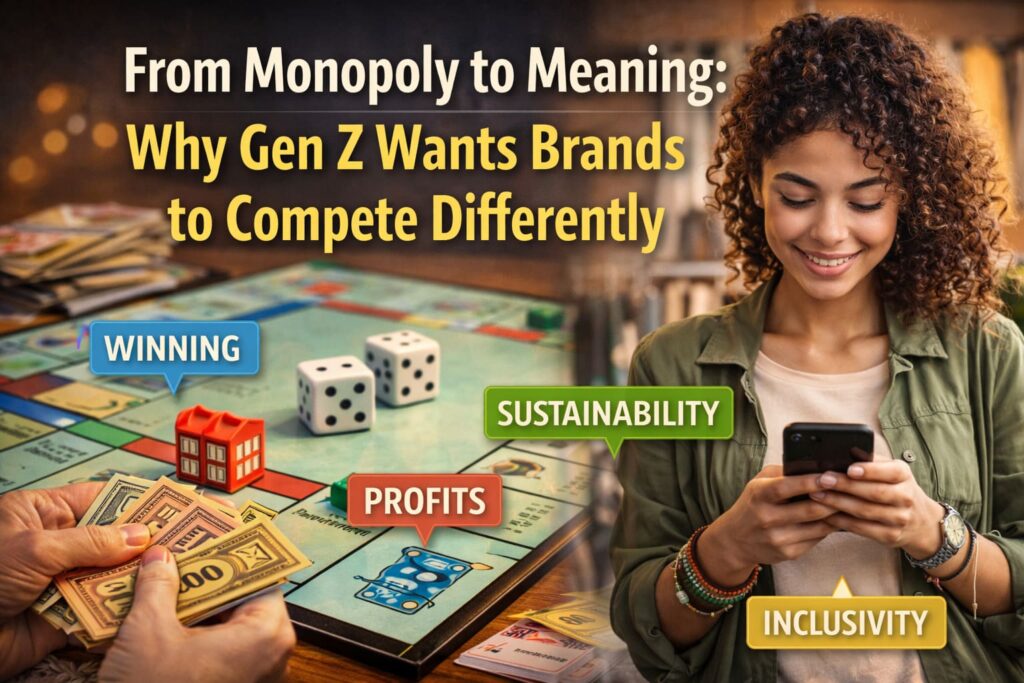
Picture a 22-year-old deciding between two skincare brands. She has six browser tabs open, one of which is a Reddit thread from three years ago where real customers complained about delayed refunds. She’s cross-referencing TikTok reviews, checking if the brand’s founder has said anything problematic, and comparing shipping policies side by side. She’s not being paranoid. She’s just shopping. This is what a considered purchase looks like now, and it barely resembles the process that marketers designed their funnels around ten years ago.
For most of the twentieth century, brand competition was a fairly legible game. You fought for shelf space, ad impressions, and market share. Winning meant dominance — more distribution, more awareness, more revenue than whoever was next to you on the shelf. Loyalty programs existed to make switching expensive. The brand with the biggest reach and the most consistent messaging usually won. Size was its own kind of moat.
That model hasn’t disappeared, but it’s been complicated enormously. A large follower count no longer signals trustworthiness to a generation that grew up watching influencer scandals and brand pivots in real time. Reach without relevance is noise. Price competitiveness still matters — a lot, actually — but it’s rarely enough on its own. What’s changed is the additional layer of scrutiny that now sits between brand message and purchase decision.
Some of this shift comes from information overload and some from genuine disillusionment. Gaming culture offers a useful lens here: younger consumers have grown up watching competitive ecosystems — the kind of winner-takes-all thinking that produces things like monopoly big baller official results — and they’ve grown skeptical of narratives where one dominant player simply gets to define the rules. That skepticism transfers directly to how they engage with consumer brands. They’re not opposed to winners. They’re opposed to the idea that winning alone justifies how you play.
This isn’t purely idealism, either. Gen Z is a price-aware, practically minded cohort that has come of age during economic instability, student debt, and a housing market that’s largely shut them out. When they choose to pay more for a brand, or stay loyal to one, it’s usually because that brand has demonstrated something worth the premium — consistency, honesty, usefulness, or genuine community. When a cheaper alternative shows up that meets the same standard, they switch. Brand meaning is not a replacement for product quality or fair pricing. It’s what earns the benefit of the doubt when things are close.
What follows is a grounded look at what Gen Z actually rewards in brands, why the old competitive playbook is losing its edge, and what changes are practical enough to act on without overhauling an entire organization.
Why “Winning” Looks Different Now
Market share thinking trained brands to chase acquisition above almost everything else. More customers, more revenue, higher valuation. Retention was important but often treated as a metric to optimize quietly, while acquisition got the big budgets and the press releases. The assumption was that if you were everywhere — in stores, in ads, in cultural moments — loyalty would follow naturally from familiarity.

Gen Z has largely broken this assumption. Familiarity without trust doesn’t convert the way it used to. A brand can be incredibly well-known and still feel irrelevant or untrustworthy to this demographic. What earns traction now is closer to a mix of trust, consistent usefulness, and a sense that the brand actually knows who it’s talking to. That last part is subtle but important. Generic brand voice aimed at a demographic of 75 million people reads as exactly that — generic — to someone who spends half their online life in niche communities where specificity is the norm.
It’s worth being clear: convenience and value still win plenty of purchase decisions. Amazon didn’t lose Gen Z as customers. Fast fashion didn’t disappear. Budget grocery brands picked up share during inflation and kept it. Brands that assume younger consumers will automatically pay a values premium for mediocre execution are misreading the data. The competitive shift is real, but it’s happening alongside price pressure, not instead of it. The brands doing well are usually the ones that manage to offer both — reasonable value and a credible identity.
Gen Z Is Skeptical for a Reason
The skepticism isn’t generational moodiness. It’s a learned response to being marketed at from an extremely young age across an enormous number of channels, many of which turned out to be unreliable. Ad fatigue, influencer overexposure, greenwashing scandals, and performative brand activism have all trained younger consumers to read brand communication defensively. When a company posts a black square or suddenly pivots to environmental messaging right before a product launch, the audience notices. They’ve seen this pattern many times.
Greenwashing in particular has done lasting damage to brand trust in the sustainability space. A 2023 Edelman Trust Barometer report found that trust in business communications has declined across consumer segments, with younger cohorts showing particular sensitivity to perceived inauthenticity. When a brand’s sustainability page uses vague language like “committed to a better future” with no specifics, it reads as either dishonest or incompetent — neither is a good look.
- Vague sustainability claims with no third-party verification or concrete data
- Sudden shifts in brand values that align suspiciously with current news cycles
- Responses to social issues that feel scripted or templated
- Influencer promotions that aren’t clearly disclosed or feel obviously transactional
- Customer service that’s warm in public and dismissive in DMs
- Prices that are never transparent — hidden fees, vague shipping costs, confusing return terms
- Brand “community” that’s actually just a closed feedback loop the company controls
- User-generated content repurposed without clear credit or compensation
- Engagement bait (polls, “tell us your thoughts”) with no visible follow-through
- Copying the aesthetic or language of a subculture without any genuine connection to it
The challenge for brands is that most of these signals don’t feel like mistakes from the inside. They feel like reasonable marketing choices. That’s the gap: what seems efficient or low-risk in a planning meeting can read as cynical to an audience that has spent years developing pattern recognition for exactly this kind of content.
Meaning Is Not Just “Purpose”
“Purpose-driven brand” has become a content category unto itself, which is partly why the term has lost most of its meaning. Announcing that your brand stands for something bigger than profit used to carry some weight. Now it’s the baseline expectation, and the announcement itself signals very little. What Gen Z reads as meaningful is usually quieter and more operational than a mission statement.

Meaning, in practice, tends to look like: a returns policy that doesn’t punish the customer; a product that does what the marketing said it would; a company that responds to criticism without immediately going defensive; a content strategy that treats the audience as adults. These things don’t make headlines. They accumulate. The brands that have built genuine loyalty with younger consumers — think of how Glossier initially grew, or how some smaller food brands have built cult followings through newsletter transparency — usually did it by being consistently useful and honest, not by crafting a bigger vision statement.
Community matters here too, but not the kind that’s manufactured. When younger consumers talk about a brand feeling meaningful, they often mean that engaging with it connects them to other people who share their values or interests. That kind of connection can’t be built by a PR team; it has to grow from the actual product experience and the genuine interactions around it.
Transparency as a Competitive Advantage
Transparency has become one of the most under-leveraged competitive moves available to brands right now, mostly because it feels risky to teams that are used to message control. The instinct is to present only the best version of everything — cleanest supply chain claims, fastest shipping promises, easiest return framing. The problem is that Gen Z shoppers are going to go find the Reddit thread anyway.
Brands that lead with honest framing — “our shipping takes 7–10 days because we’re a small team and we don’t want to overcommit” — often generate more goodwill than brands that promise fast delivery and miss it. The bar isn’t perfection. It’s accuracy. A realistic product photo with real lighting performs better in actual conversion than an over-retouched hero image, because the review photos are going to show the real thing anyway.
| Brand behavior | How Gen Z reads it | Trust impact | Better approach |
|---|---|---|---|
| Vague “ethically sourced” claims | Probably not true or not verified | Negative or neutral | Name specific certifications or suppliers |
| Shipping estimate: “3–5 business days” | Might be accurate, might not be | Neutral until delivery | Show real average from recent order data |
| 30-day returns, no questions asked | Probably has fine print | Skeptical until tested | Show actual return process in 3 steps, no asterisks |
| Pricing page with visible tiers and feature breakdown | Respects my time and intelligence | Positive | This is already the better approach — do it |
| Founder explaining a supply chain problem publicly | Honest, credible, human | Strong positive | Lead with this, not damage control language |
Community, Not Control
A lot of brand community initiatives fail because they’re designed as broadcast channels with audience participation features bolted on. The brand posts, the audience reacts, the brand curates the best reactions into content. That’s a media strategy, not a community. Real community involves some degree of letting go — allowing criticism, incorporating feedback that changes something actual, and treating vocal customers as collaborators rather than content sources.
Creator partnerships are a good example of where this plays out visibly. Brands that give creators genuine creative latitude — including the right to say something honest and mildly unflattering about a product — tend to get more credible content than brands that script every integration. The audience can feel the difference. An unboxing video where the creator is clearly reading talking points lands differently than one where the creator is genuinely reacting, including noting something they weren’t expecting.
Feedback loops matter specifically when they close. If a brand runs a survey, asks Instagram followers what they want, or opens a community forum, the follow-through question becomes: did anything change? Gen Z consumers have been conditioned to expect that input gets collected and rarely actioned. The brands that break this pattern — by literally saying “you asked for X, here’s what we did with it” — stand out sharply.
Tone of Voice Matters More Than Many Teams Think
Brand copy has its own kind of uncanny valley. Writing that’s trying too hard to sound young reads immediately as performative, and it tends to embarrass the brand far more than a slightly formal but honest tone would. Fake relatability — using slang that’s three months past its peak, or adding “no cap” to a product description — signals that the brand is watching from the outside, not actually part of anything.
On the other end, pure corporate-speak creates distance that’s equally alienating. The goal isn’t youth culture mimicry. It’s just being clear and human. There’s a practical version of this that most brands can reach without a complete overhaul.
- Real: “We tested this with 200 customers before launch” — Forced: “Our fam helped us perfect this 💯”
- Real: “Returns take about 5 business days to process” — Forced: “We’ve got you covered, always!”
- Real: “This product isn’t for everyone — here’s who it works best for” — Forced: “Perfect for anyone who wants to level up”
- Real: “We made a mistake with the January batch. Here’s what happened” — Forced: “We’re on a journey and learning every day”
- Real: “Free shipping on orders over $50, standard 7 days” — Forced: “Because you deserve to treat yourself 🛍️”
- Real: Founder posting an honest Q&A about pricing — Forced: Brand account posting “Our fave question: why do you care so much about your customers??”
- Real: Product page that shows actual ingredient list prominently — Forced: Product page that leads with “powered by nature’s wisdom”
The distinction isn’t just tone — it’s whether the communication actually contains useful information. Human copy tends to be specific. Performative copy tends to be vague and emotionally inflated. Specificity is the shortcut to sounding credible, because it’s harder to fake.
Values Still Need Price and Product
It’s worth saying directly: no amount of brand meaning saves a bad product. And no mission statement competes with a meaningfully lower price when a consumer is working with a tight budget. The brands that have cracked this cohort aren’t usually the most values-forward ones; they’re the ones that offer real value and then layer in authenticity on top of that foundation.
A good example is the budget meal-prep space, where several DTC brands have built genuine Gen Z followings not by being the most ethical brand in the category but by being genuinely affordable, transparent about ingredients, and responsive on social media. The “values” component is baked into the operational choices — honest communication, fair pricing, no hidden subscription traps — rather than performed in campaign copy.
| What brands say they compete on | What Gen Z actually checks before buying |
|---|---|
| Brand values and mission | Recent customer reviews (especially 2–3 star range) |
| Quality craftsmanship | Reddit threads and unfiltered community posts |
| Sustainability commitments | Third-party certifications or specific sourcing data |
| Exceptional customer service | How the brand responds to complaints publicly |
| Community-first philosophy | Whether the community seems real or curated |
| Founder story | Whether the founder’s behavior matches the story |
How Brands Can Compete Differently (Without Pretending)
Most of what needs to change is operational rather than creative. The biggest trust gaps aren’t usually in brand identity or visual language. They’re in the gap between what the website says and what the customer actually experiences after checkout.
Post-purchase communication is one of the most neglected touchpoints in most brand strategies, despite being one of the highest-trust moments. What happens after someone buys shapes whether they recommend the brand to someone else. A thoughtful shipping email with real information and a genuine point of contact does more for retention than a fifth touchpoint in the acquisition funnel.
- Rewrite your returns and shipping policy in plain, honest language — then put it where people actually look
- Respond to negative reviews publicly, specifically, and without defensiveness
- Create one piece of genuinely useful content per week (not promotional — useful)
- Audit your influencer partnerships: are they disclosing clearly? Do they actually use the product?
- Add a FAQ that answers the questions people actually ask in reviews, not the ones you want them to ask
- Find one piece of customer feedback from the last 30 days and implement something visible from it
- Check your automated email sequence — does any of it sound like it was written for a persona rather than a person?
- Remove any sustainability or values language that you can’t back up with specifics
- Set up post-purchase emails that give real order status and a named contact, not a generic support ticket address
- Read your brand’s last 50 comments across platforms — note the pattern of what people are actually saying
Where Brands Get It Wrong
The most common mistake isn’t malice — it’s overreach. Brands that try to claim too many values, too quickly, with too little operational backing, almost always get caught out. A “purpose page” that exists primarily for PR purposes but isn’t reflected in the product, the pricing, or the support experience reads as exactly that. Gen Z consumers are practiced at spotting the gap between brand narrative and brand behavior, and they talk about it.
Trend-chasing is another consistent failure mode. A brand that was earnestly communicating one set of values in 2022, pivoted to a different set in 2023, and is now leaning into a third in 2025 has a credibility problem that no individual campaign can fix. Consistency is trust-building; pivoting to follow cultural moments reads as opportunism. The brands that age well with this cohort tend to have a stable core — usually something operational and honest — and simply do that thing better over time.
Copying Gen Z slang is perhaps the most immediately visible mistake and also the most avoidable. Corporate accounts that use current slang either nail it completely (rare, requires genuine internal Gen Z voices with real authority) or embarrass themselves in ways that get screenshotted and circulated. The risk-reward calculation rarely justifies it.
A Better Competitive Playbook
The brands navigating this well aren’t necessarily doing anything revolutionary. They’re doing ordinary things — good product, clear communication, honest policies, accessible support — with enough consistency that they’ve built genuine credibility. The framework isn’t complicated.
| Area | Old competition mindset | Gen Z-friendly approach | Quick test |
|---|---|---|---|
| Messaging | Aspirational brand language, broad appeal | Specific, honest, useful | Would a real customer say this in a review? |
| Operations | Promise high, manage expectations later | Set realistic expectations upfront | Does your returns policy match what support actually does? |
| Community | Curated social proof, tightly controlled | Open feedback with visible follow-through | Can you name one thing customer feedback changed? |
| Values | Mission statement, purpose campaign | Values visible in pricing, sourcing, and support | Do your operational choices match your stated values? |
None of this requires a rebrand or a large budget. It requires honesty about where the gaps are, and the willingness to close them before someone finds them on Reddit first. The McKinsey analysis of Gen Z consumer values is worth reading for any team that wants to understand the data behind this cohort’s decision-making — but the operational implications aren’t complicated. Compete honestly, communicate clearly, and follow through consistently.
Gen Z isn’t asking brands to stop competing. They’re asking brands to compete in ways that are useful rather than just loud. The difference between a brand that earns genuine loyalty from this cohort and one that cycles through campaigns without retention usually comes down to whether the experience after purchase matches the promise before it. Meaning without execution fails. Execution without trust now underperforms, too.
The brands worth betting on are the ones that have figured out those two things don’t have to be in tension.